Showing posts with label peak oil. Show all posts

Monday, 6 June 2011

Fracking Dover

According to the BBC: "Coastal Oil and Gas Ltd, based in Mid Glamorgan, wants permission to drill an exploratory borehole at Woodnesborough to test coal and shale for gas. The company said it mainly wanted to extract methane from coal, but did not rule out shale extraction in future."

Kent News have covered the story as well: "Plans for a firm to explore the possibility of mining gas from a site near Dover has been slammed by the Green Party amid claims it could lead to the use of a highly controversial method blamed for sparking earthquakes."


Appalling news. Let's hope that KCC turn down their application, but they don't have a very good reputation for protecting the land against mineral extraction. Given the concerns about earthquakes, let alone the fact that extracting more fossil fuels is simply wrong, East Kent really doesn't need this.

Tuesday, 15 March 2011

FFS!

Quote of the week has to go to Monbiot: "The government also plans to introduce what it calls a Fair Fuel Stabiliser. This policy might be blessed with the best abbreviation since the proposed City University of Newcastle-on-Tyne was rechristened, but it’s likely to ensure that demand remains strong."

My colleague Steve was arguing on the Politics Show why fuel duty should not be reduced and I think the events in the Middle East are just the latest in a long line of reasons stretching from climate change to sustainability to health.

I fully accept that the impact of high prices are felt on the less well off but this can be dealt with fairly simply by personal tradeable carbon quotas. A cap on carbon use across the country with fair share access to oil/gas/coal would mean that people who use less than their equal share could sell their excess quota to others, offsetting the cost of lower amounts of carbon that they have used, FFS!

Wednesday, 5 January 2011

Too much happening to blog about...

  • Disgusted that they can call this green. Treating animals (and Nature in general) in this way is as far from green philosophy as you can get. Raising pigs in factories also has no place in a green society. Disgusting.
  • Latest U-Turn by Clegg, this time on control orders. What happened to the liberal part of Liberal Democrat?
  • Castro's medical mission marches on to the shame of the civilised West. This time Cuban medics are in force in Haiti. 1200 of them. How many have the US or UK sent I wonder?
  • Maidstone's town centre manager is quoted as saying: "Recession, what recession?" after higher than normal sales in the post Christmas period. I'm sure he meant no offence but I doubt the public are in such a boyant mood, I suspect they were having one final splurge before hunkering down.
  • It seems that the FT are worried about the burgeoning oil price and its threat to the recovery. Oil hit $95 last week and I think the $148 high was part of the reason for the last economic collapse. Peak oil happened in 2006 and White's Law says the economy needs energy.

Monday, 3 January 2011

Why Greg Clark is wrong on parking

Just been interviewed on Radio Kent about Greg Clark MP's announcement that he is to scrap central government restrictions on the number of parking spaces for new developments.

While I welcome the devolvement of powers generally, this mustn't be done in a way that is detrimental to the wider society. Greg Clark talked about the frustrations of home owners having to drive around trying to find somewhere to park after a long day at work and while I often share that frustration as I don't have any parking at home, increasing the supply of parking is the wrong thing to do.

More parking will lead to more cars, more congestion in towns and on major road. It will be a short term fix for our long term problem of how we get around. Pump prices are at an all time high and set to go higher with the VAT increase. The supply of oil cannot increase globally as we reached peak supply in 2006. The cost of personal transport using oil will continue rise and continue to pollute. Building more parking spaces does not help.

There is a further problem with increasing the number of spaces per house as it encourages councils to build bigger houses. In Kent we have complete Tory control of our councils and they are generaly more keen on building lower density / bigger houses than meeting the needs of poorer people. Affordable housing is more dense and smaller, yet we will see prices rise further if bigger houses are built.

Devolution of powers must have limits or we will end up with anarchy and vested interests ruling the day.

Tuesday, 7 December 2010

Peak oil was in 2006

It sort of slipped by mainstream news, but a few weeks back the World Energy Outlook published by the International Energy Agency declared that Peak Oil happened in 2006 and that oil production will be around 68 million barrels a day for the next 25 years. Read more here if you can't afford the $120 price tage for the report (or would prefer to spend your $120 on one and a half barrels of crude instead...). Strangly, the BBC simply reported the expected 53% growth in energy demand, failing to mention that there wasn't going to be the energy available to meet this demand, thus pushing prices skyward or throwing the world into even deeper recession.

The impact that this will have on the world's economies cannot be underestimated. Oil is the primary driver for most economies and there will chaos until governments and people work out how to live without economic growth. But it's worse than that, there is already a rebalancing of economies starting. The Celtic Tiger was shot, stuffed and mounted in the IMF board room last week; Greece has gone the same way; and Portugal is following close behind. Of course, none of them have benefitted from having their own currencies and the additional flexibility that this gives them, but being Eurozone has only hastened the inevitable.

Finding a way to descend the oil ladder without civil unrest is going to be a big challenge for the next few decades. Living as if there is a future would be a good start.

Tuesday, 17 August 2010

Yoof unemployment

The leader in the Indy yesterday explained why being 18 in 2010 was the worst possible age to be with falling places at university and up to 200,000 disappointed university hopefuls who don't get their first choice and if they do get a place, they will end up with £25k of debt and poor job prospects. The TUC published a league table of youth unemployment which shows that Kent is in the worst 10% for rising youth unemployment (up 79% sine last year) and Medway is the worst place in the country (up 158%).

There is plenty of rhetoric about the aspirational society that we live in and equal levels of angst by the right wing press about immigrants stealing jobs, yet I see very little analysis about how these are connected and even less about the skill mix required for a sustainable society.

As energy prices soar under peak oil, the outsourcing of manufacturing and farming to automation will reverse. People power will become cheaper than fossil power and the country will need more people doing physical jobs. Yet we have seen the country moving rapidly away from training people to do manual, technical and engineering jobs, prefering to not just outsource them to automation, but to outsource them to other countries and to bring in migrant labour.

None of these options are sustainable. Energy prices will rise to a point where automation is too expensive. It is already widely reported that the conditions in other countries' factories can be akin to slavery as our outsourcing rids us of external costs of production. And relying on migrant labour to pick our crops is the clearest indication of all that we don't have the right people in the right jobs to do the work the country needs.

So am I suggesting that we need to stop people going to university and start working on the fields? Am I suggesting that we go back 200 years? No, I'm suggesting that the country has the balance wrong, the 'aspirational' society wrong, and the value of jobs wrong. I am saying that there is too much focus on university places and white collar jobs and not enough acknowledgement that working on a farm, or sweeping the roads, or building houses are important and valuable jobs.

The 'aspirational' society that leads young people to value banking over producing food has got its priorities wrong. Bankers do not feed us, they do not clothe us, do not build our houses, or keep our streets clean, yet we insist that they are paid phenomenal sums of money while labourers are at the bottom of our wage spectrum.

All the time society fails to value those professions that provide our basics we will continue to have a society based on greed and a society that cannot meet its own basic needs. We need to shift the focus to prevent us undermining these basic needs.

How about doing this by paying workers a decent wage based on their value to society, rather than their educational attainment or their contribution to economic growth?

Wednesday, 11 August 2010

Triple crunch starting to bite

The triple crunch of the economy, climate and resource depletion is starting to kick in.

While the Indy report that food price inflation is set to hit 4% by the end of the year in the UK, in Pakistan food prices have quadrupled in days. The impact of the devastating effect of climate change and commodity prices will be felt everywhere, but especially by the poor.

The only way to solve the triple crunch is through equality, reduced consumption and respect for our planet. Sadly, most political masters across the world can't see this or don't want this.

Saturday, 5 June 2010

Economics, society and oil

Been catching up on a couple of US peak oil blogs. Take a look at James Howard Kunstler, who wrote The Long Emergency and John Michael Greer. Both take a fairly depressing view of society and its refusal to face the fact that oil is becoming a bit of a problem...

We have built the last 150 years of Western civilisation on and un-endless supply of cheap oil. Ignoring the impact that this is having on our climate and currently the Gulf of Mexico, cheap oil will end soon and the key question is what will happen?

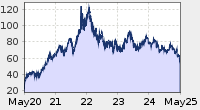
A cursory understanding of our economy will show the deep connection between economics and oil. Looking at the FTSE 100 and the Dow Jones over the last 5 years and the price of oil shows a remarkable correlation and we need to begin to understand what the causal relationship between these two is.

FTSE 100 last 5 years:


Dow Jones last 5 years:


Oil Price last 5 years:

Friday, 28 May 2010

Oil rush in Kent

More bad news in Kent. An oil rush is probably an exageration, but an energy company has been given permission to drill for oil in Bidborough.

Is there any chance that some focus on renewable energy is given? There is no excuse for mining for fossil fuels. Give it up.

This is from Hazel Dawe / Kent Green Party:

Kent Green Party has been examining the area proposed for oil drilling at Bidborough. Dr Hazel Dawe, Chair of Kent Green Party, comments:

“My husband, Steve, and I walked the Weald Way from Tonbridge to Bidborough, and back, past the potential oil drilling site. Tonbridge and Malling Borough Council is unhappy because of the local roads which will be used by lorries servicing the site, but has permitted the development regardless. Road access includes the already busy Brook Street: access to two secondary schools and to West Kent College which is still a building site with heavy lorry traffic. Then there is Haysden Lane and Upper Haysden Lane: two very narrow country lanes. At the peak there could be a lorry every two minutes.

“But more concerning is that the planned main access route near the site, Gate Farm Lane, is clearly marked as ‘Unsuitable for heavy goods vehicles.’ It is a very steep, single carriageway country lane [SEE PHOTOS ATTACHED]. Lorries cannot pass each other in the lane so special passing areas will have to be built with the attendant destruction and disturbance of ancient hedgerows. The potential for accidents has been dismissed as planning officers believe that the lorry drivers will all drive safely at all times, apparently, in an area with no pavements.
“The noise has the potential to disturb enjoyment of our beautiful Haysden Country Park. The drill site is in the High Weald Area of Outstanding Natural Beauty, a Special Landscape Area and part of the Metropolitan Green Belt. Tonbridge and Malling Green Party is disturbed that the proposal is in breach of both national and local policies for landscape protection(1).”
ends

Further information: Dr Hazel Dawe, Chair, Kent Green Party on 01732 355185 or mobile 079444 71083. Contact address as above. Published by H.Dawe and promoted for Kent Green Party, both at 27, Audley Avenue, Tonbridge, Kent TN9 1XF.

Notes:
1. Policy references: C3 High priority will be given to conservation and enhancement of
natural beauty in the region’s Areas of Outstanding Natural Beauty (AONBs); EN26 Development proposals will only be permitted within the AONB if they protect or enhance the natural beauty and special character of the landscape; CP4 The High Weald AONB will be conserved and enhanced. Net loss of biodiversity will be prevented, and enhancement measures encouraged. (FROM: report of Head of Planning Applications to Planning Applications Committee 11th May 2010 – Tunbridge Wells Borough Council).
NB. The drilling site comes under Tunbridge Wells Borough Council however access to the site would be through A21 via A26 Quarry Hill, Brook Street, Upper Haysden Lane which are under Tonbridge and Malling Borough Council.

Thursday, 15 April 2010

Climate change

March was the third warmest month (globally) on record and the second warmest winter ever (again globally - I haven't forgotten how cold it was here!). The climate scientists at East Anglia have been cleared of claims that they were trying to mislead people.

We have very little time left to stop runaway climate chaos. We cannot afford to have politicians who campaign against windfarms or call for lower fuel prices. We need politicians who want alternatives to oil - which means more public transport, more insulation of homes and businesses, less cars, less road freight and renewable energy. Reducing tax on petrol would be a pointless short term measure that would damage our ability to decarbonise.

The Lib Dems claim they are green but merely scratching the surface shows they are not. Only the Green Party is.

Friday, 5 February 2010

Shell's job losses: is Maidstone to blame?

Of course not but there is a tenous link - Shell was founded in 1897 by Viscount Bearsted (who was plain Mr Samuel at the time) and whose residence was to become Mote House in Maidstone. While Mote Park has moved into public ownership and is the jewel in Maidstone's crown (the 180 hectare park is in the centre of Maidstone), Shell is another matter.

Apart from the whole issue of digging finite resources up and promoting them as if they do not damage and will never run out, Shell has hardly got a great record as a company.

This piece is out in today's Morning Star: "Shell has announced that it will axe another 1,000 jobs this year despite raking in over £6 billion in profits. The bombshell was dropped after the company reported a 69 per cent fall in annual profits to £6.1bn"

It must be a tough life when your profits fall to just £6 billion. Of course it is a much tougher life when your job is axed.

Saturday, 5 December 2009

RBS: No interest in our planet

Yesterday around 20 yound people gathered outside the Royal Bank of Scotland in Maidstone to protest about the investment in extraction of tar sands in Canada, and its effects on the indiginous people there (and lets not forget climate change).

It was great to see another clear demonstration of how little the Daily Hate Mail understands young people - these people care about our collective futures and are prepared to stand up for what is right.


Thursday, 3 December 2009

RBS Protest in Maidstone tomorrow

Maidstone FOE are holding a protest outside the Royal Bank of Scotland tomorrow against the funding of oil tar sands mining.

From Facebook:

Date: Friday, 04 December 2009
Time: 15:45 - 16:45
Location: Outside RBS in town
Street: 94 High St
Town/City: Maidstone, United Kingdom


The royal bank of scotland spends almost £8 billiion a year on funding tar sand projects in Canada, thats £8 billion of the taxpayers money being spent on one of the most enviromentally damaging projects on the planet!!

This project It is destroying the homelands of Indigenous communities, polluting their drinking water, destroying an area of ancient forest larger than England.

What can we do?

We are going to stage a demonstration outside the maidstone branch, with some of us lieing on the ground dead on top of big oil splats. Others will be talking to passerbys about the impact of the bank and the tar sands.

Or just come along and show your support.

Also a camera team from the BBC will be there, so remember, BIG SMILES!

Monday, 3 August 2009

Kicking the habit

Doom and gloom for Monday morning, "Warning: Oil supplies are running out fast - Catastrophic shortfalls threaten economic recovery, says world's top energy economist" (The Independent)

Many of us have been watching the concept of peak oil for some time, calling for urgent action to kick the oil habit. Last year oil hit $150 a barrel, just as the world economy also hit its peak before going into free fall. Oil prices went into a similar but even more dramatic free fall, dropping to $40 per barrel by Feb 2009. Prices have climbed slowly since to $70 this morning.

Almost all of the world's economy is based on oil and basic economics dictates that as supply for a product falls and demand doesn't fall by a similar amount then price will increase. This rise will be greater with more 'inelastic' products like, er... oil. Just like climate change, many (especially in the oil industry) have their heads in the sand - 'we're not running out of oil' etc. While it's true there is a lot of oil left, extracting it is getting harder, slower and more expensive - and of course it is a finite resource.

The concept of using finite resources as if they will never run out is perhaps the greatest mistake of all. The only resources we should consider expendible are the renewable ones. All finite resources should be used with care and as investments. No company would pay its staff from share capital, it would only ever use that to buy capital purchases and get the company running, yet we are running our economy on millions of years of stored sunlight energy and we won't be able to do it for very much longer.

The second comment on the Indy piece was sad and true: "we can be fairly certain the last of the oil will be used fighting [futile] wars to secure the last of the oil."

Time to kick the ol' oil habit, renewable energy patch anyone?

Tuesday, 30 June 2009

Doom and gloom at the OECD

The latest doom and gloom economic pronouncement from the OECD is hardly surprising. In the past year of crashing economies nothing has been done to address the underlying issues of corporate greed, over consumption, lack of investment in sustainable green collar job, the banking / monetary system and most of all our dependency on finite fossil fuel resources.


The oil price has steadily risen over the last six months to its pre-peak level, a sure sign that the demand / supply gap has closed. I doubt whether the price will rise to its Jun 08 peak any time soon as any rising price of oil will have a negative impact on the rest of the world's economy and as the world economy dives the demand for oil drops along with its price.

All the time we have a world economy predicated on oil, coal and gas, all of which are finite and will therefore fall in supply we will grind along on this long spiral of recession. We need to kick the carbon habit and base our main economic input (energy) on somthing that it a little less finite

Friday, 10 April 2009

Next global recession due shortly

Happy headlines on the Energy Bulletin: The IEA warns of shortages - "The next oil crisis is coming"

It is suggesting that oil prices will hit a new high in 2010 as the global recession eases and growth restarts in earnest. As reserves are falling and production will not meet demand, the price of oil will soar again creating inflation and recession. Boom and bust and bust.

The only solution is to kick the fossil fuels habit quickly, to accept that economic contraction is necessary and good as long as it is a managed. We can't carry on consuming at our current levels, therefore the economic has to reduce in size. We either do it in a chaotic and unfair way that means poorer people suffer while the wealthy are protected or we do it in a managed way ensuring that jobs are created in new sectors that consume less and have more intrinsic value to society.

What we don't want is to replace one form of rampant consumerism with another. There is no point is paying people to scrap their cars so they can replace them with new ones just to keep an industry going, or pumping money into electric cars rather than public transport.

Economic recession doesn't have to hurt too much as long as it is managed properly. All change is uncomfortable as we are creatures of habit, but building communities based on localism and ensuring that goods are of a high quality and built to last (no built in obsolescent) have to be good for society.

Tuesday, 4 November 2008

Peak Oil

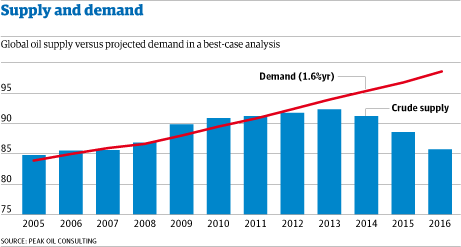
This graph from the Grauniad last week neatly shows the Peak Oil effect. The government have their head in the sand about one of the three major crunches facing the planet (the others being the climate and the economy). Earlier this year I commented on the rising oil price and expected it to continue to rise, but I hadn't factored the world recession that reduced consumption very slightly, just enough to push the price back down.

This graph shows a peak in production in 2013. Others have predicted the peak to have been this year, either way the important point is not when supply peaks, but when demand outstrips supply (as it appears to have done in 2007). The price of oil rockets when demand outstrips supply and the knock on effect on both people and the economy is hard felt.

The report in the Guardian tells how industry are beginning to taking the threat seriously.

What does this mean for people? It will hit the poorest hardest and while we all need to use less energy, energy should be shared fairly, not based on ability to pay.

Oil supply

Sunday, 5 October 2008

Express claims oil to fall

"America finally rescues banks and now petrol could fall to 74p a litre" was the front page headline of the Daily Express yesterday; the article goes on to suggest oil prices falling to $30. I don't read the Express (although it has an excellent crossword) but the headline caught my eye as it defies all logic.

Colin Cambell of ASPO has predicted, in his latest newsletter, peak oil production to occur this year at 84 million barrels of oil equivalent a day. The peak shown in his graphs is more of a table top mountain and oil production looks flat and stable for a few years. He also states that there are unknowns with biofuel production that will skew the peak and production from oil sands is only viable with prices over $100.

My previous predictions on oil prices were before the current world recession (damn, should have seen that coming). The recession has reduced demand for oil and helped the price to fall from its previous high. With demand and supply being very close and the elasticity of price being low the price of oil is swinging wildly.

The Express's claims that the bail out will reset the world oil prices is therefore bizarre. If the economy is righted by the bail out (which it won't be) and begins back on its continuous growth path, oil prices will rocket again as demand rises forcing us back into recession. Boom and bust at increasing frequency - and a great example of why continuous economic growth cannot happen on a finite planet.

If the economy stays in recession then oil prices will remain low for a few years as demand stay low, however the large reserve of oil sands will not be exploited until the price exceeds $100 and this could act as a balancer to keep the price at around $100. Biofuels are the other big unknown, if they are increased then there is more oil supply, prices will fall and people will starve reducing demand further. If oil consumption stays at around its current level for any more that a couple of years irreparable damage will be done to the climate. This is worsened by a switch to coal.

The only acceptable future is one of managed energy descent and renewables.

Monday, 18 August 2008

A Green New Deal

I need to plug this fantastic paper published by the New Economics Foundation. A Green New Deal is an impressive view of the crunches that are hitting the world and sets out what we can do about it.

From their website: "The global economy is facing a ‘triple crunch’: a combination of a credit-fuelled financial crisis, accelerating climate change and soaring energy prices underpinned by encroaching peak oil. It is increasingly clear that these three overlapping events threaten to develop into a perfect storm, the like of which has not been seen since the Great Depression, with potentially devastating consequences."

The credit crunch hit us all last year, with the ensuing economic downturn. The political spin on the effects is as expected "it will be over by Christmas" etc. although they seem to be getting a bit more wobbly as time goes on. They might be right if it weren't for the energy crunch that is driving inflation up. Fuel and food are far higher than this time last year, and people are feeling it with inflation at 4.4% in July.

The climate crunch is slower to feel, Al Gore's analogy of 'how to boil a frog' is all too true. The effects are being felt: 150,000 deaths each year due to climate change; environmental refugees arriving in the UK; today's reports from the Indy on rapid coastal erosion - and a further interesting piece with welcome comments by Lord Smith the new head of the Environment Agency; and jellyfish invasions around the coast. The climate crunch might be less obvious to individuals but it is starting to get noticed here.

The energy crunch, peak oil, peak gas, peak coal etc, has had a stark effect over the past 12 months. Fuel prices soared in the spring (£1.40 for a litre of diesel) and seem to have abated as the economic downturn bites. The volatility of oil prices must not be underestimated and the high prices are driven by consumption and demand which has lowered a little in the past few months. The economics of oil mean that uneconomic supplies become viable as prices rise increasing the volatility further. Gas supplies are particularly fragile in the UK and while we have some coal left the speed at which all the ancient stored sunlight is being used up means that we need renewables more urgently than ever before.